Here we go again! This is our second financial transparency statement as a family, and it still feels both deeply vulnerable and strangely liberating! But mostly vulnerable.
Let’s just get straight to the punchline.
In 2025, the two of us made $155,049.15. After taxes and business expenses, we netted $112,160.21 (the average household income in our county is $188,967, and median income is $127,116).
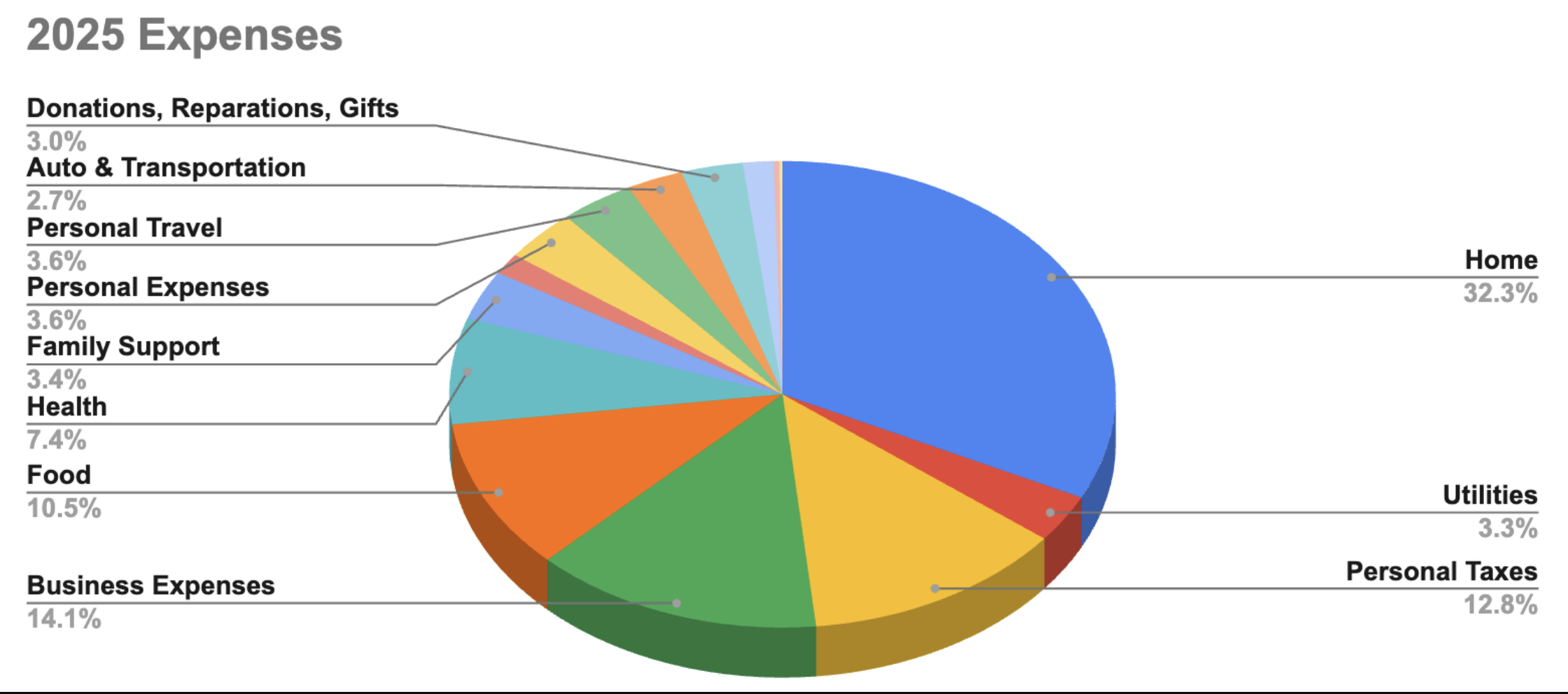
Our expenses totaled $159,788.35, and once taxes and business expenses were removed, we spent $116,899.41 to support our family of four (the two of us, our child and elderly mother).
For those new to this practice, we (Kazu and LiZhen) both work in the Gift Economy, and part of our commitment is sharing our finances transparently with our community. You can read more about why we do this here, and read our previous statements here.
See the Spreadsheet with Full Breakdown
Last time, we realized we didn’t share much about how emotionally complex this practice is. While Kazu was used to sharing the finances of the nonprofit organization he used to run, sharing our personal finances feels way more vulnerable.
We didn’t mention that it was actually a lot of work for us to get here, or that we had moments of tension that we had to work through between us because of all of the feelings it stirred up. So this time, we wanted to slow down and share a little bit more of what lives underneath the numbers.
More details about the numbers can be found below.
Sense of Worth Tied to Money
One edge has been the unevenness of our income. Kazu’s work currently earns more, and that brought up different fears for each of us.
KAZU: For most of my life, I earned very little and lived simply. But in recent years, my income increased in ways I never imagined - sometimes as much as $10,000 in a single speaking gig!
And that for me is really vulnerable to share!!! I’ve always seen myself as a simple person who makes sacrifices for “the work.” Making less aligned with my ego-image of simplicity and humility. So it was easier to be transparent about my finances when I made less.
But now that I make so much, will people judge me? Will they think I sold out and went mainstream?
Ultimately, this attachment to identity is its own form of ego. It prevents me from fully appreciating the reality that so many people want to support me. While my income is still modest by Bay Area standards, trusting that people will not judge me because of how much money I make remains a real edge for me.
LIZHEN: For most of my life, I have also earned little and lived simply, and for the most part, I still do. That is where the vulnerability lives for me.
Personally, I love the challenge of living on little — it’s fun and creative! I love how ALIVE it feels. I ask myself daily what is necessary vs kneejerk, what nurtures life, and what elevates love… and I try not to take on more than that. I don’t like the weight of carrying a lot. I want to deepen in this lifestyle as a matter of loving the earth.
But this way of living — is it legible to others? In this world, there is something about low income that carries the stench of undesirability. I grapple with this fear. Do people think I am worth less because I make less? Do they assume I’m not good at what I do?
Ultimately, this fear isn’t about money. It’s about feeling secure in my belonging and in my contributions. It’s a young self that speaks and is asking for a different way to understand my value.
For both of us, these fears point to how deeply money has come to represent worth – something we grieve. Regardless of our income, we are both devoted to the work of liberation. And yet, we both can’t help but question our own value when it comes to money.
This is one of the gifts that transparency gives us. It points us to our edges, and gives us guidance on where we need to continue to heal.
Vulnerability of Transparent Spending
Another edge is in knowing that people can see how we spend our money.
You can’t see every detail, but it’s a little embarrassing to admit that we spent almost as much eating out ($7,495.91) as we did on groceries ($8,281.42). And we spent almost $1,000 on coffee and snacks!!!
And while we’re here, we’ll own an even more embarrassing thing….. Well, Kazu will. See, we live a very simple life, but this past year, Kazu decided to give himself one indulgence: watches. Kazu loves nice watches, and he spent $673.29 on buying several this year!!!
KAZU: Ooh that’s embarrassing to say out loud. I decided to allow myself to have ten watches, and after that I will stop!!! I promise! Hold me to it! I’m ashamed!!!
And here we go with more fears that people will judge us. What will you think of the fact that we ate out so much, or that Kazu has fancy watches? Will people continue to support us?
But there is a gift in this fear as well: it keeps us honest. Before this practice, we didn’t track our finances closely. Now we meet weekly, maintain a food budget, and are committed to redistributing more of our income through donations and reparations. Transparency keeps us aligned with our values.
Sharing our Finances
A few years ago, we decided to pool all of our money. Everything we earn goes into one pot, regardless of who earns it.
We each receive monthly “allowances” for small personal spending – money to buy each other gifts, to go out with friends, etc. And we get different amounts not based on income, but on need. LiZhen gets $150, and Kazu gets $250 - not because he earns more, but because he’s more prone to stupid impulse buys (see above).
We see this as a small practice of radical resource sharing that we hope expands outwards. We wonder what it would be like if more resources were shared in larger and larger circles, without consideration for who earns more and who deserves more, divorcing earning power from access.
Debt, Savings, Assets and Safety Net
After our last statement, several people asked if we have savings. This invited us into another layer of vulnerability, but was a welcome invitation.
We typically hold somewhere between $25-40K in our bank accounts – much of which is earmarked for repairs.
Our home – a 100+ year old, 1,200 sq ft two-bedroom – is half owned by Canticle Farm, where we live. This is the only way “ownership” was ever possible, but we cover most of the repairs and maintenance, which are extensive in an aging house. This is largely why our expenses exceeded our income this year.
Over five-years, we’ve replaced the electric box, heating system, insulation and removed mold from our walls. In the near future, we will have more mold remediation, a bathroom renovation, rebuilding our home office (because of mold) and replacing the electric wiring.
Gratefully, we carry no other debt and pay off credit cards monthly.
We own a paid-off 2020 Honda Clarity. We share one car, and try to ride our bikes as much as possible. LiZhen owns 1/8 of an ancestral home in Penghu, Taiwan that her grandfather built.
We do not receive any financial support from family; rather, we provide financial support to them and do not anticipate any inheritance. We feel deeply privileged not to face daily financial stress. At the same time, we do hold some longer-term anxieties—around childcare, elder care, and the ongoing upkeep of our home.
While we don’t have a financial safety net from our families, we are blessed to be sustained richly by things that would never show up on a spreadsheet: community and land.
We are proud residents of Canticle Farm, a community of 40ish people re-villaging in the midst of collapse. We share meals, raise our children together, practice nonviolence and restorative conflict, tend to the garden, care for animals, experiment with the Gift Economy and support each other through our hardships.
We are held by a larger circle of deep community - relationships that give us faith that we will be caught if we ever fall. This is an immense privilege, one far too rare in our society.
Anticipating 2026
This year, we both aim to prioritize work aligned with our vocational call, even when it pays less.
For LiZhen, this means serving as co-director of SoULL (School of Unusual Life Learning) during a leadership transition from the founding director. Transitions are always vulnerable, therefore SoULL is currently able to pay just $15,000 for the year. LiZhen is offering their work generously because of their belief in the work.
For Kazu, it means reducing speaking engagements to focus on building the Fierce Vulnerability Network and on his writing, both things that bring in almost no income.
We continue to trust that listening to emergence and intuition will sustain us – through your generosity.
Short Term – And Now the Finances
You can also see all of the information below in a spreadsheet, which includes more details for each line item.
And before we get into the actual numbers, if you would like to support our work, we would be so grateful to receive your support. You can support us by donating on Kazu’s website or LiZhen’s website.
Expenses
Home & Utilities - $56,902.95
Having to spend more than 50% of our net income on housing is not ideal, but this number includes all home repairs, having to purchase a new fridge and washing machine, all of our utilities and purchasing everyday household items like dish soap.
Personal Taxes - $20,422.76
This includes our total payment for tax year 2024, as well as pre-tax payments for 2025. Because we are both self-employed, we are trying to get better at pre-paying our taxes. And to be honest, we are also looking into tax resistance. The idea that our money is going to support what is occurring in Gaza and funding ICE is unbearable to us.
Business Expenses - $22,466.18
Both our income and expenses are a bit bloated because it includes business expenses. Half of this is travel – including an entirely self-funded book tour when Fierce Vulnerability was published and expenses for a workshop LiZhen co-led in Slovenia. Kazu also purchased many copies of his own books to give away and to offer on a Gift Economy. We also had to buy a new computer this year and spent over $2,000 in online services, which includes both of our websites, Zoom accounts, etc.
Food - $16,735.27
We now have a food budget, and are limiting eating out a lot more this year. We are now also grateful members of a CSA run by fellow Canticlers.
Health - $11,77.91
We continue to invest heavily in our health. In addition to our healthcare premiums which we have to pay for out-of-pocket, this includes costs associated with acupuncture, therapy, Chinese herbs, supplements, etc.
Family Support - $5,467.58
We are so grateful to be in a position to support members of our family when they need it.
Parenting - $2,331.39
Expenses related to raising Yeye, including childcare, activities, supplies, toys, etc. We anticipate this increasing in the coming years.
Personal Expenses - $5,715.23
This includes entertainment, personal care (haircuts, etc.) and shopping – which includes clothes, personal items and… watches.
Personal Travel - $5,715.23
This is mostly for a family trip to Taiwan and Japan that we are about to take, as well as parts of last year’s trip to Taiwan and Japan. We still have a lot of family overseas – including LiZhen’s elderly father – that we try to visit at least annually.
Auto & Transportation - $4,383.74
Our car is paid off, so most of this is insurance. Our car is a plug-in hybrid, so we only spent $545.71 on gas!
Donations, Reparations and Gifts - $4,799.67
Now that we are tracking our finances more, we hope to increase this this year.
Cash Spending - $2,384.75
We want to be using more cash to support local businesses, so less money is going to banks and credit card companies. And, that makes accounting a bit harder to track. We will continue to do better, but this represents all miscellaneous spending from cash. The vast majority of this was during our trip to Asia in February of 2025. Both Japan and Taiwan are still mostly cash economies, so we use a lot more cash there, and we were not tracking our spending at all during that trip.
Education - $448
Mostly Kazu’s ongoing Chinese classes
Financial Fees - $228.64
Bank fees, foreign transaction fees, etc.
Income
We are hoping to track this a little more this year as well. Because we work in the Gift Economy, technically all income is a “donation.” So it is hard to know how much of our income was a general donation, versus how much of it was in response to a workshop, versus how much was for a book that someone received at a workshop, etc. And, if someone signs up as a monthly donor at a workshop, how much of that do we track as income from a workshop versus a general donation?
These numbers are our best guess, but again we hope to be better this year in tracking income streams.
Presentations - $84,286.06
From public speaking and presentations for different communities.
Donations - $34,032.91
General donations, income from Substack, etc.
Counseling - $15,947.93
Income from private 1:1 sessions.
Workshops - $12,445.00
Donations received from workshops participants.
Book Sales - $6,466.83
Both book royalties and direct sales at events. Again, many books were “sold” at in-person workshops, but it was hard to separate out what was for the workshop and what was for a book, so in reality this number was probably higher.
Interest - $1,665.56
Solar Refund - $204.86
This was the amount of electricity we sold back to the grid from our solar panels.
